FPGA & Reconfigurable Computing
Programmable hardware as a compute substrate, turning Python-trained neural networks into custom IP blocks that run on Artix-7 silicon through HLS, RTL refinement, and SoC integration.
Overview
Reconfigurable computing sits in a useful gap. ASICs give peak efficiency but commit silicon to one workload; CPUs and GPUs are flexible but pay in joules per inference. FPGAs let you trade between the two, re-fabricating the datapath to match the model in front of you.
The work here is about how to actually close that gap in practice: choosing the right compute primitive (LUT, log-domain, approximate), wrapping it in a clean AXI4 SoC, and pushing it through Vivado without losing timing.
Sub-areas
- High-Level Synthesis (SUB-01): Algorithmic descriptions in C/C++ compiled to RTL via Vivado HLS, with pragma-driven optimisation of pipelines, dataflow, and memory partitioning.
- RTL Architecture (SUB-02): Hand-tuned Verilog where HLS is insufficient, including clock-domain crossings, FIFO sizing, and pipelined arithmetic for predictable timing.
- AXI4 SoC Integration (SUB-03): Memory-mapped AXI4 between custom accelerator IP and embedded ARM cores, featuring DMA-driven activations and bitstream-baked metadata.
- PPA Optimisation (SUB-04): Power, performance, and area as first-class design knobs, with Vivado reports parsed into sweep dashboards for repeatable exploration.
- Quantisation & Approximate Compute (SUB-05): Sensitivity-driven quantisation pipelines that pick precision per layer.
- Verification (SUB-06): Bit-accurate C++ models paired with cocotb testbenches, providing coverage-driven regression on representative DNN slices.
Active Projects
Hybrid Neural Accelerator
Reconfigurable LUT / logarithmic compute engine for edge-AI inference, featuring a mode-switching INT8, LNS, and INT4 datapath prototyped on Artix-7 XC7A200T.
- −75% DSP usage vs. standard INT8 baseline.
- Timing closure at 225 MHz; WNS +0.42 ns.
- Accepted at GLSVLSI 2026 Late Breaking Session.
Sobel Video Co-Processor
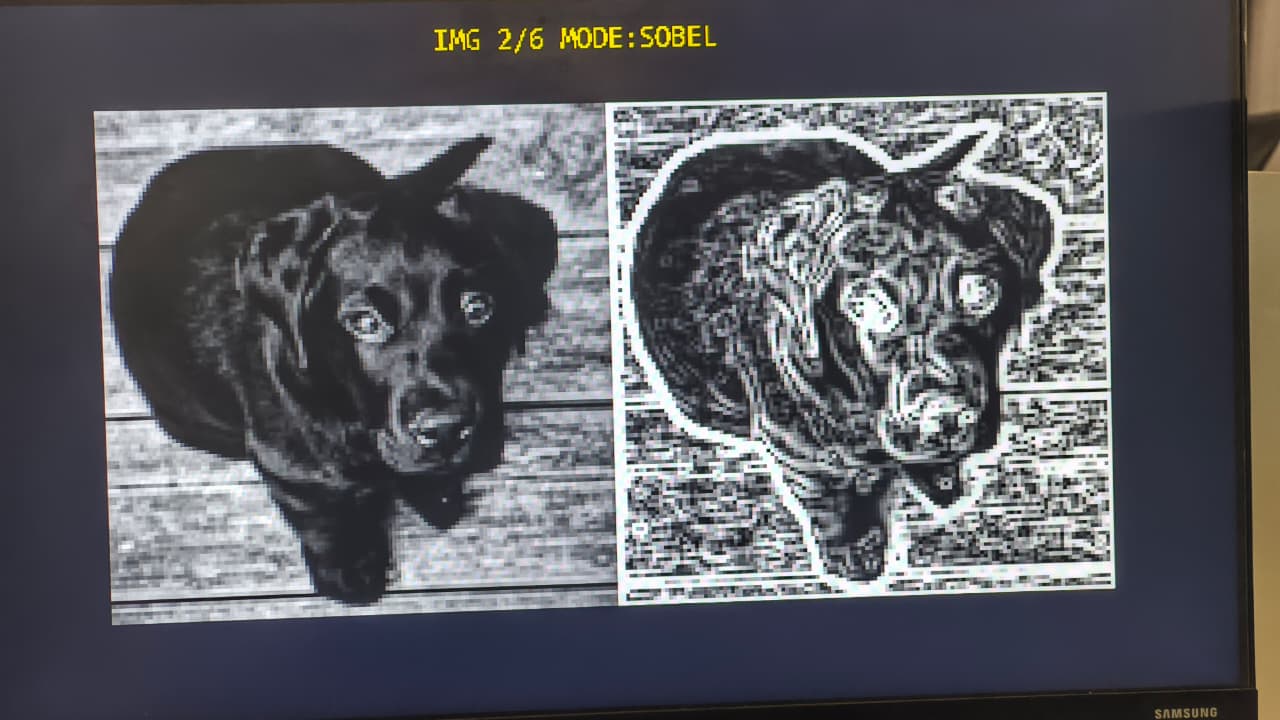
Real-time 3×3 convolution video filter (Sobel, sharpen, blur, emboss, threshold) built in Vitis HLS and dropped into a flat-Verilog 720p HDMI pipeline, shown live as a split-screen RAW │ FILTERED view.
- II=1 line-buffer streaming kernel: one pixel in / one pixel out per clock.
- Shift-add operators only, so 0 DSP slices, 2 BRAMs, and ~1% of the fabric.
- Timing closed with margin; ~0.44 W on-chip, no soft-CPU and no AXI.
CNN Digit Detector
Full PyTorch-to-FPGA pipeline that trains a 2D CNN on an 8×8 digits dataset, exports fixed-point weights, synthesises via Vitis HLS, and displays live digit recognition over HDMI.
- Conv–ReLU–MaxPool–FC pipeline at II=1, 200 MHz.
- ap_fixed<16,6> arithmetic; weights baked as ROM constants.
- Live HDMI display with per-class logit bar chart.
Interactive FPGA Adder
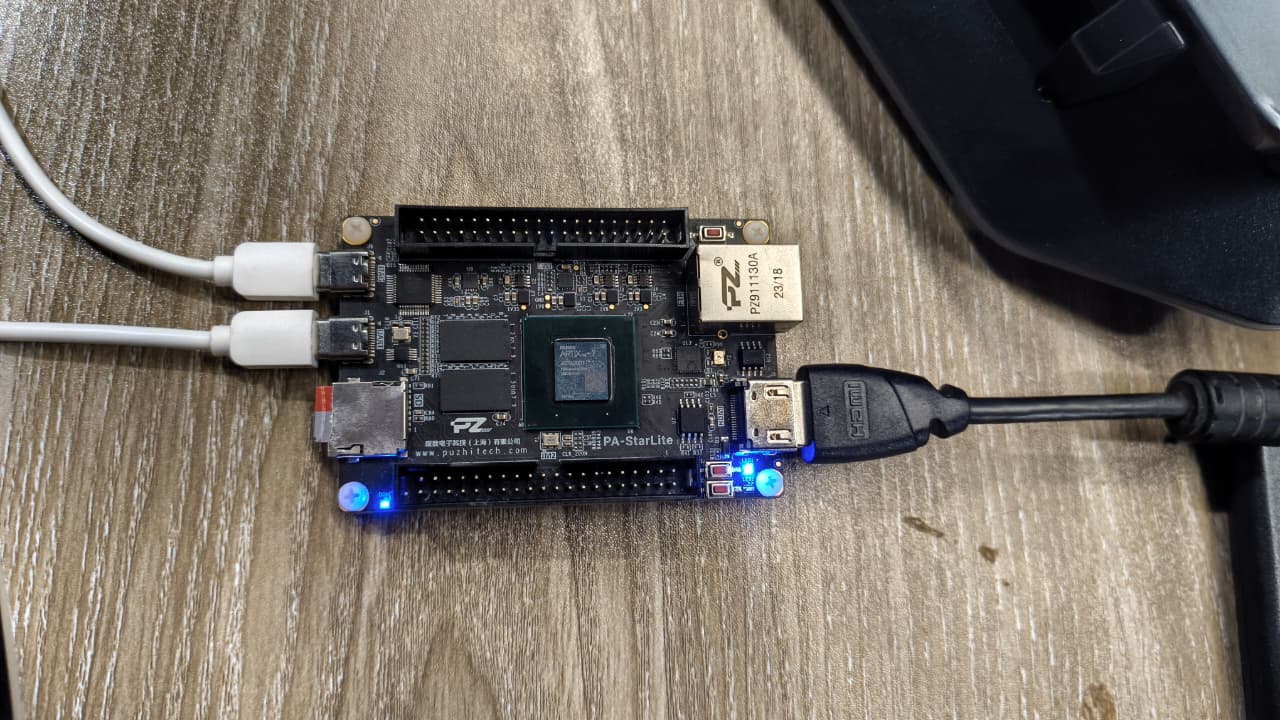
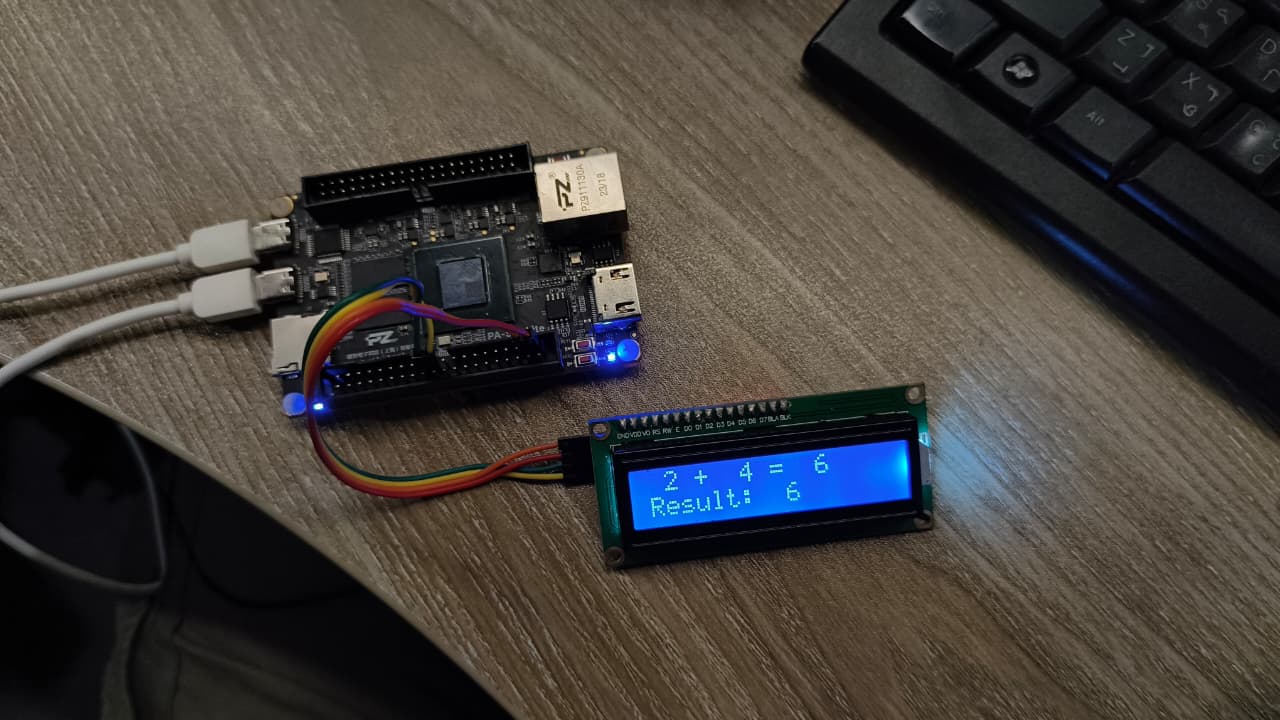
Interactive 4-bit accumulator implemented in Verilog HDL on the PA-StarLite board, featuring debounced button control, a custom dynamic I2C LCD driver, and real-time UART logging.
- Three-state accumulator FSM (Num1 Entry, Num2 Entry, and Result calculation).
- Custom Verilog I2C master controller driving a 16×2 character LCD screen.
- UART telemetry interface log outputs to PuTTY console at 115200 baud.
Toolchain
| AMD Vivado Suite | End-to-end FPGA design covering RTL, synthesis, implementation, and timing closure. |
| Vitis HLS | High-level synthesis from C/C++ to optimised RTL. |
| Artix-7 XC7A200T | Target silicon with 215 K LUTs, 740 DSP slices, and 13 Mb BRAM. |